
What It Actually Costs
What a Single Spot Trade Actually Costs: Five Layers, Taken Apart
The fee is only the first layer. This breaks a spot trade into five: the 0.1% base rate, the BNB discount, referral kickback, the spread, and funding costs.
How much does a single spot trade actually take from you? Most beginners know there is "a fee" but cannot name the number, and have no idea there are several other layers of cost underneath it.
This article takes the cost apart, layer by layer. All fee figures come from Binance's official fee schedule, checked on 2026-08-27. Fees change — check the official page when you read this.
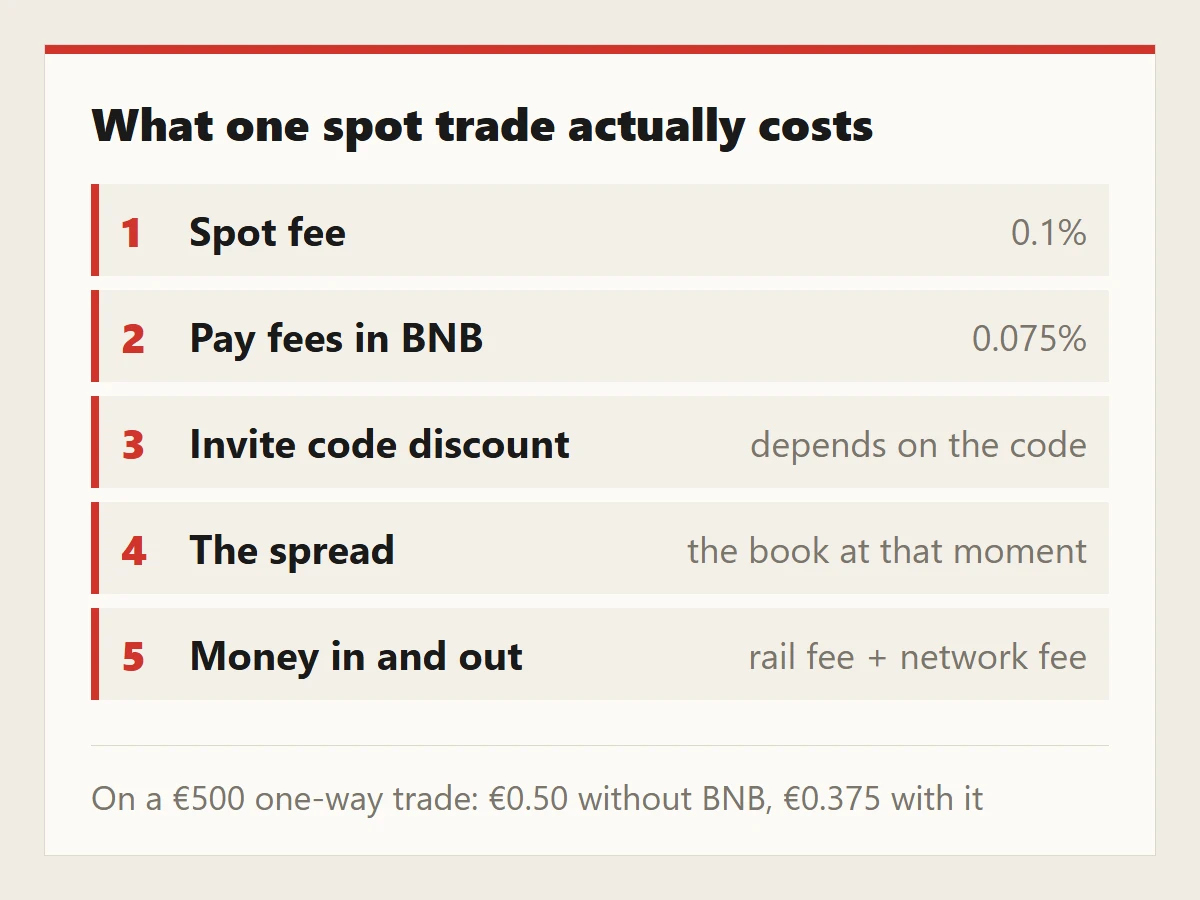
Figure: compiled by this site. The numbers match the sections below; the live rates on the platform are what actually apply.
Layer 1: the 0.1% spot fee
For a Regular User (VIP 0), the spot trading fee is 0.100% maker and 0.100% taker.
"Maker" means your order does not fill immediately and sits on the order book. "Taker" means your order fills instantly against someone else's resting order. At VIP 0 both rates are the same, so as a beginner you do not need to worry about the distinction.
On a 500 EUR buy: 500 x 0.1% = 0.50 EUR.
Note that the fee is charged in both directions. You pay once when you buy and again when you sell. A full round trip is 0.2%, or 1.00 EUR.
Layer 2: pay fees in BNB, get 25% off
If you hold BNB in your account and switch on "use BNB to pay for fees", your spot fee gets a 25% discount — 0.100% drops to 0.075%.
Same 500 EUR buy: 500 x 0.075% = 0.375 EUR. Round trip 0.75 EUR.
That switch is not necessarily on by default. You have to go into your account settings and confirm it. This is the single most commonly missed saving for beginners.
One caveat: the discount requires you to actually hold a BNB balance, and BNB's own price moves. Stockpiling BNB purely to save on fees is not worth it — hold roughly what your actual trading volume needs.
Layer 3: the fee discount an invite code can carry
Binance runs an invite system: when someone who signed up through an invite code pays trading fees, the inviter receives a share of them. The inviter can choose to pass part of that share on to the person they invited, which shows up as a fee discount.
How much is passed on is set by the inviter when the code is created, so it differs from code to code.
Our disclosure: this site is an independent affiliate partner of Binance (Official Binance Affiliate Partner). We are not the official Binance website. The invite code we use is BN6321. Signing up with our invite code carries up to a 20% trading fee discount*.
We receive a share of the trading fees from the platform. That share is paid by the platform and does not add anything to your cost.
* The actual rate is whatever the exchange page displays and may change with policy. Do not trust any absolute "sign up and save X%" promise — including ours. Open the sign-up page and read the number it actually shows you.
Layer 4: the spread, which beginners almost always ignore
The fee is advertised. The spread is not.
An order book always has a highest bid and a lowest ask, and the gap between them is the spread. When you fill instantly with a market order, you are paying that gap.
- On high-volume major pairs (BTC against EUR, for instance) the spread is usually small enough to ignore next to a 0.1% fee
- On thin, low-volume pairs the spread can be several times the fee. You think you saved on commission while losing more on the spread
This is exactly why beginners should start with the most liquid pairs rather than the small coins with the interesting names.
Layer 5: getting money in and out
Trading fees are only part of your total cost. There are two more ends:
Deposits. Different funding routes cost different amounts. Card rails usually carry a fee, while P2P may charge nothing at the platform level — but the price you accept already contains the counterparty's markup.
Withdrawals. Moving coins to an on-chain wallet costs a network fee, and the amount depends on the network you pick and moves with congestion. The withdrawal screen shows the actual figure before you confirm — read that number before you press confirm.
The gap between networks can be enormous. The same coin over a different network can cost many times more. This is where beginners quietly lose the most.
Adding the layers up
Buying 500 EUR and later selling, counting only the trading fee layer:
| Setup | One side | Round trip |
|---|---|---|
| Without BNB discount | 0.50 EUR | 1.00 EUR |
| With BNB discount | 0.375 EUR | 0.75 EUR |
Add the spread, the deposit cost and the withdrawal network fee, and your real total is meaningfully higher than this table.
This is not meant to scare you off. It is meant to make one thing obvious before you start: if you plan to move in and out often, cost compounds fast. The more frequently you trade, the larger the share it takes.
How to check what you were actually charged
Do not go by feel. Binance's trade history shows the actual fee amount and currency for every fill.
The first thing to do after your first trade is pull up that record and reconcile it against the numbers in this article. People who can check their own books are much harder to sell a "low fee" story to.
Summary
- Base spot fee is 0.1%, charged in both directions
- Turning on BNB fee payment brings it to 0.075% — the easiest saving to miss
- Fee discounts differ by invite code; trust the sign-up page, not the marketing
- On thin pairs the spread can cost more than the fee
- Deposits and withdrawals each add a layer; always read the network fee before confirming
Work out the cost first, then decide whether to start. Not the other way round.
After this, two questions usually come next: From Sign-Up to Your First Filled Trade: Seven Steps, and What to Check at Each, Choosing a Funding Rail: What Each Type Really Costs and How to Work Out Yours.
the official Binance sign-up page (code BN6321). The page states trading cashback of up to 20%; the real rate is whatever it displays. Udhez is an independent affiliate partner and may earn a commission.
Fee data checked 2026-08-27 against Binance's official fee schedule. Rules in this industry change often; verify on the official page before acting. This is not investment advice.