
Red Flags
What Scams Aimed at Beginners Look Like: Three Rules and Four Setups
Support never contacts you first. Never hand over your password, codes or seed phrase. If someone wants remote control of your device, hang up.
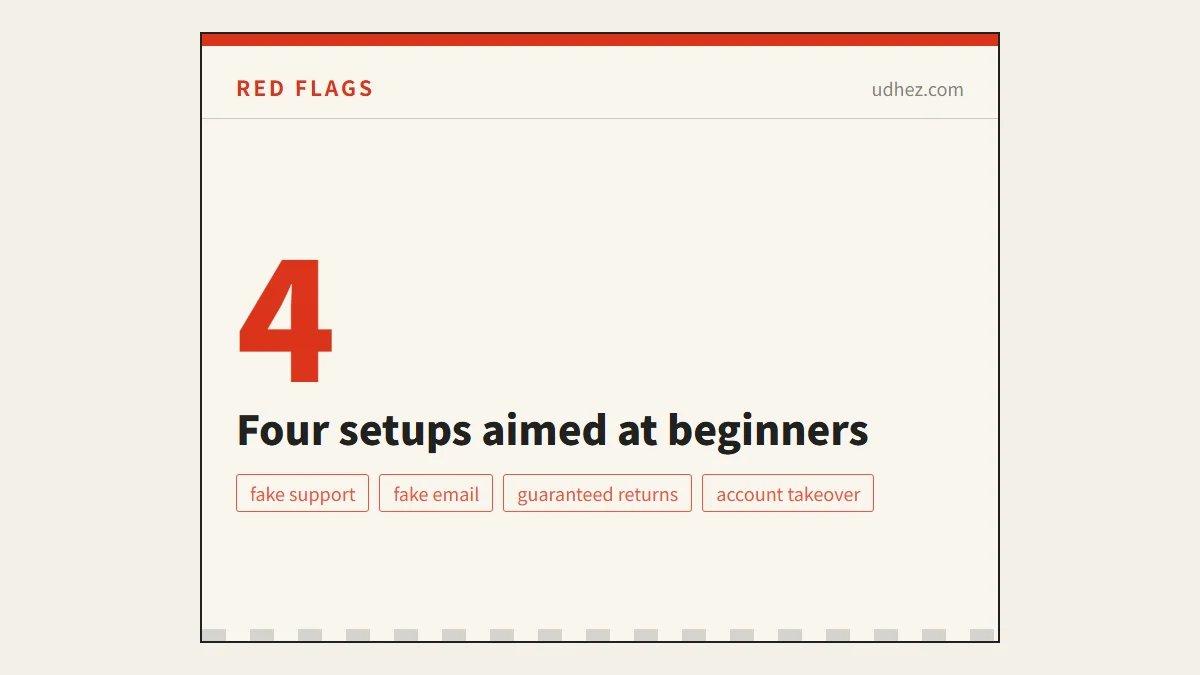
Before you put money into any platform, learn the handful of scams that target beginners.
They have one thing in common: they all happen while you are still unfamiliar with the process, and they all manufacture time pressure. By the end of this page you will notice they are basically the same shape.
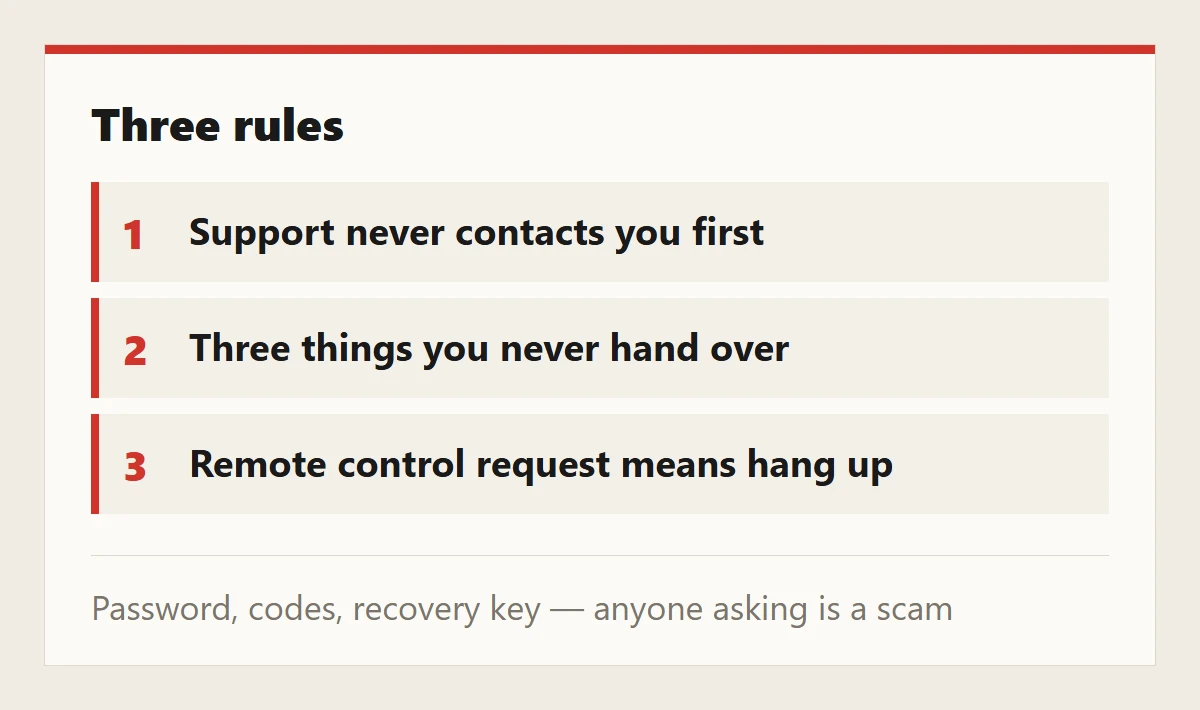
Figure: compiled by this site. The numbers match the sections below; the live rates on the platform are what actually apply.
Rule one: support never contacts you first
This is the most important rule here.
Support is something you initiate. You open a ticket at the official help centre, and an agent replies. Anyone who approaches you first claiming to be exchange support — on Telegram, WhatsApp, SMS or by phone — is an impostor. No exceptions.
The usual opening line is "we have detected unusual login activity on your account and need to verify it immediately." Panic first, thinking later.
Rule two: three things you never hand over
- Your password
- Verification codes (the six digits from SMS, email or your authenticator)
- Your seed phrase or private key (the wallet recovery words)
Official exchange support will never ask for any of these. They do not need to — the platform has its own internal ways to verify you.
Verification codes especially: the entire point of that number is to prove you are the one acting. Reading it out to someone means you personally completed their authorisation. Scammers say "this is our verification code, please read it back to confirm your identity" — no legitimate process ever requires you to speak a code aloud.
Rule three: if someone wants remote control of your device, hang up
If they walk you through installing AnyDesk, TeamViewer or any "remote assistance" software, that is a scam and there is no second interpretation.
Real exchange support does not need to see your screen, let alone operate your phone. Once that software is installed they can see everything you type, including your password and your codes.
The four common setups
1. Fake sites and fake apps The domain is one letter off and the page is a pixel copy. The credentials you type go straight into the scammer's database.
Defence: always enter from your own bookmark. Never from a link someone sent you, and never from a search ad. Install apps only from the official app store, and check the developer name.
2. "Mentors" and signal groups Someone adds you to a group full of daily profit screenshots, and a "teacher" walks you through trades. The screenshots are fabricated and most of the "students" are plants.
The test is simple: if someone could reliably make money, why would they do it for you for free? Their income is your fee rebate, your losses, or your deposit outright.
3. Managed accounts "Hand me your account and I'll guarantee X% a year." Nobody can guarantee the price of a crypto asset. Any promise of guaranteed returns is a scam — that alone is enough to decide, you do not need to examine the rest.
4. Recovery services You have already been scammed, and someone contacts you offering to recover your funds for an upfront fee. This is a second scam aimed at victims, specifically hunting people who already fell for the first one. Once funds move on-chain they are essentially unrecoverable, and no private outfit can change that.
One test that catches almost all of them
You do not need to memorise every variant. Nearly every scam meets all three of these at once:
- They approached you (you did not contact them first)
- They create urgency ("immediately", "right now", "or your account is frozen")
- They want you to do something irreversible (transfer, give a code, install software)
When all three line up, stop — regardless of how reasonable the explanation sounds.
If it already happened
- Change your password and reset two-factor authentication in the official app immediately
- Check your withdrawal whitelist and API permissions for entries you did not add
- Open a ticket through the official help centre — not through any link someone gave you
- Do not engage any "recovery service"
If you are actually going to open an account, go in through this link — BN6321 fills itself in. Udhez is an independent affiliate and may earn a commission.
Checked 2026-08-27. Not investment advice. Related: what a single spot trade actually costs.