Start Here
Three Questions to Answer Before You Open an Account
This page is not about how to open an account. It is about deciding whether you should — and deciding not to is a perfectly good outcome.
This page is not about how to open an account. It is about deciding whether you should.
If you finish reading and decide not to start, this page did its job — that is a much cheaper outcome than regretting it afterwards.
Answer three questions first
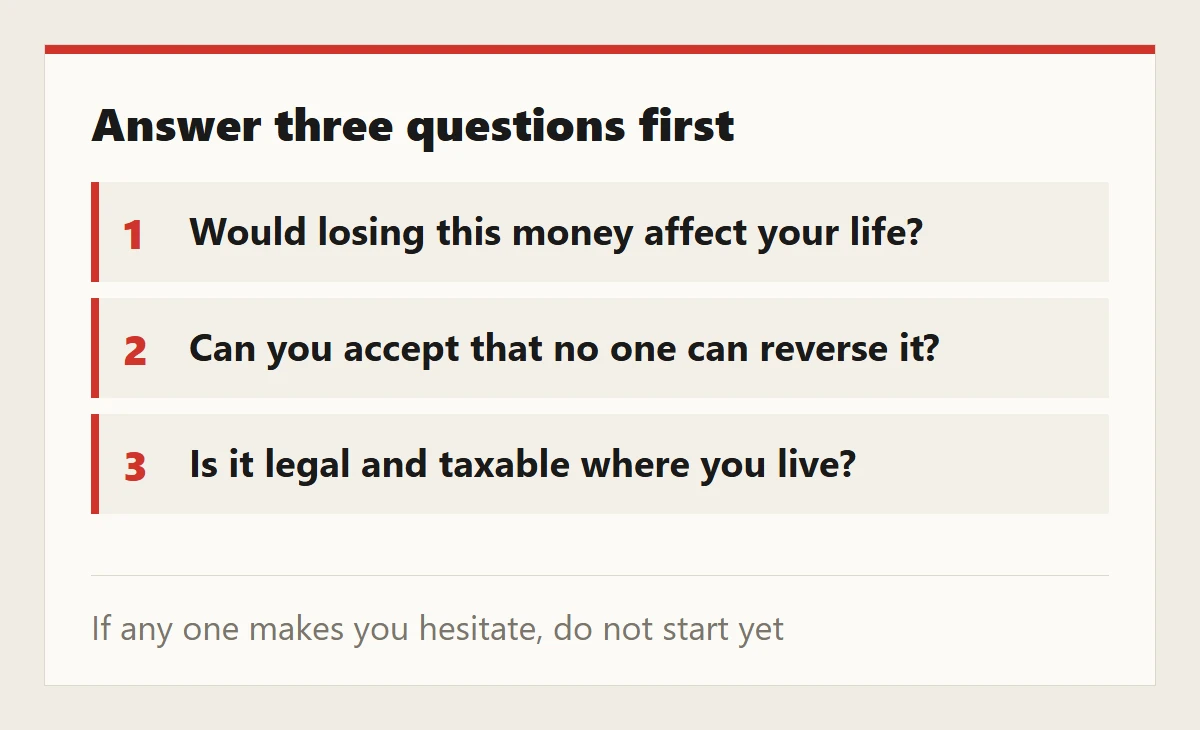
Figure: compiled by this site. The numbers match the sections below; the live rates on the platform are what actually apply.
1. If this money went to zero, would it affect your life?
If the answer is yes, do not start.
Not because it will go to zero, but because crypto moves far more than most people expect, and it tends to fall exactly when you need the money. The practical test: once the money is in, could you leave it alone for three months without checking? If not, the amount is too large for you.
2. Can you accept that no support desk can undo it?
A mistaken bank transfer has a dispute process. On-chain transfers are essentially irreversible — wrong address, wrong network, and the money is gone. Nobody can help.
This is not scaremongering; it is the design premise of these systems. What you are accepting is that final responsibility for every action is yours.
3. Is this compliant where you live?
Countries differ enormously in how they treat crypto assets and tax them, and the rules change often. Complying with local law is your own responsibility, including any reporting obligations. Check before you start, not after.
If any of these three makes you hesitate, don't start yet. Come back when it is clear — the opportunity is not going anywhere.
If you do decide to start, prepare these
A valid government ID Identity verification is unavoidable — a passport or national ID works. Check the expiry date in advance; an expired document is the single most common place beginners get stuck.
A dedicated email address Open one email address used only for exchanges, separate from your everyday one. That way, any "exchange" email arriving in your normal inbox is automatically fake.
A phone that can run an authenticator app Do not use SMS for two-factor authentication. SMS can be hijacked; the rotating codes from an authenticator app cannot.
Your backup key, written on paper Setting up an authenticator gives you a backup key. Write it on paper and store it. Do not screenshot it into your photo library — lose the phone and you lose both at once.
A sign-up link you have checked yourself
Which link you enter through decides whether a referral code travels with you — and whether you land on a lookalike site at all. Before you type anything, read the address bar: it has to say binance.com.
Before you decide, it also helps to recognise the patterns beginners get caught by: What Scams Aimed at Beginners Look Like.
This site is an independent Binance affiliate partner, not the official Binance site, and the code we use is BN6321: https://www.binance.com/join?ref=BN6321. Register through it and we receive a share of the fees the platform pays — it adds nothing to your cost. Whatever discount the sign-up page itself displays is the real number; ignore any absolute "save X% just by registering" claim, ours included.
How much to start with
More important than the amount is completing the full loop once.
The actual minimum order size varies by trading pair, and the platform has revised it more than once. The order screen shows the current minimum for that pair — trust what it displays there, not any third-party figure (including this article).
My suggestion: make your first trade an amount you genuinely do not care about, and walk the whole path — deposit, buy, sell, withdraw. What you are testing is not whether you can make money, but:
- Can money get in
- Can you read the interface
- Can money get out
That last one matters most. Plenty of people test the deposit and never test the withdrawal, and only discover the problem when they actually need the funds.
What it will cost you
Even if you never make a profit, trading itself costs. The base spot fee is 0.1%, dropping to 0.075% with the BNB discount — and it is charged on the way in and again on the way out.
On top of that come the spread, the deposit rail's fee and the withdrawal network fee. Together these are usually higher than beginners estimate. Full breakdown: what a single spot trade actually costs.
One last thing before you start
Read the red flags page first. Scams aimed at beginners almost all happen in the first few weeks after opening an account — the window where you have a balance but not yet the familiarity. That is when you are most worth targeting.
Fee data checked 2026-08-27 against Binance's official fee schedule. Not investment advice.