
Local Money Rails
Choosing a Funding Rail: What Each Type Really Costs and How to Work Out Yours
Not a country list that dates on contact — a method for working out which rails you can use, and where the cost hides in bank transfers, cards and P2P.
Once you have decided whether to start, the next practical question is simple: how does money get in, how does it get out, and what does each cost?
This page does not list which countries can use what — those lists change fast enough that writing one down dates it immediately. Instead it shows you how to work it out yourself, and what the cost structure of each rail type actually looks like.
Step one is not picking a rail — it is reading your own account
Which funding options you get depends on three things: your region, your verification tier, and the platform's current policy. All three change, and different people see different screens.
So when any third party (this article included) tells you "rail X works in country Y", treat it as a hint. The only reliable move is to log in, open the deposit page, and read what it actually lists.
If a rail is missing from your list, it is usually one of three reasons: your region is not supported, your verification tier is too low, or that rail is temporarily offline. You can fix the first two. The third you wait out.
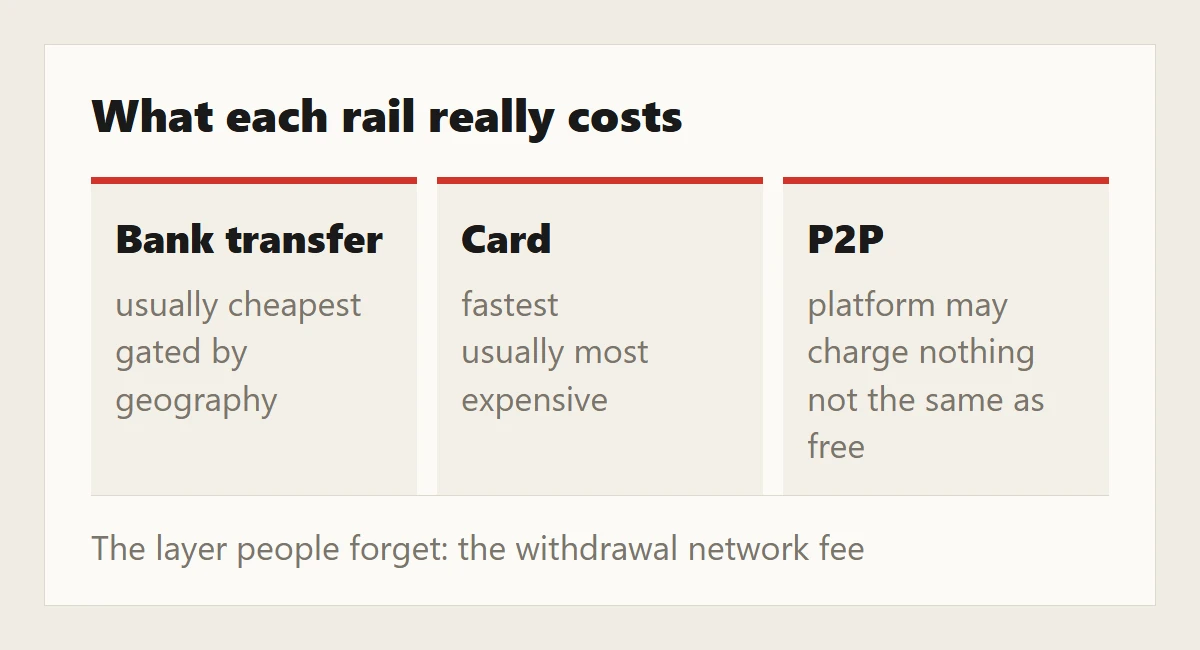
Figure: compiled by this site. The numbers match the sections below; the live rates on the platform are what actually apply.
The cost structure of the three rail types
Bank transfer: usually cheapest, but gated by geography
SEPA in the euro area is the standard example. Per Binance's own page (checked 2026-08-27), a SEPA transfer typically costs around 1 EUR, with SEPA Instant arriving within 24 hours and SEPA Standard taking up to 3 business days. Your own bank may add its own fee.
The price of cheap is the gate: these rails come with an explicit supported-country list, and if you are not on it, you cannot use them. They are also slow — when you actually need the money, three business days is a long time.
Card: fastest, usually most expensive
Cards have exactly one advantage: speed, arriving in minutes. The tradeoff is that the fee is normally noticeably higher than a bank transfer.
Also be prepared for this: some banks classify charges from crypto platforms as high-risk and decline them outright. A decline is not necessarily your fault — use a different card or a different rail. Do not retry the same card repeatedly; repeated failures can trigger risk controls.
P2P: the platform may charge nothing, which is not the same as free
With P2P you trade directly with another user. The platform may take no fee on the trade itself — but that does not mean it costs nothing.
The cost is inside the price. The quote you accept already contains the counterparty's markup. So the only way to judge whether a P2P offer is good is to compare the quote against the market price at that moment. The gap is what you are actually paying. Small gap, good offer. Large gap, find another.
Two hard rules for P2P:
- Never release the crypto before the money is genuinely in your account. A "payment successful" screenshot from the other side means nothing. Seeing the credit in your own banking app means something.
- Do not move the conversation off the platform. Once you leave it, a dispute has no record to appeal with.
The layer people forget: the withdrawal network fee
If you move coins to an on-chain wallet, there is a network fee. It depends on the network you pick, and the same coin over a different network can cost many times more.
The withdrawal screen shows the real figure before you confirm — read that number before pressing confirm. This is one of the quietest ways beginners lose money.
If you are in the EU or EEA
Transfer compliance rules in these regions require additional recipient details when you withdraw. Exactly which fields, and at what threshold, differs by platform and gets revised — go by what your withdrawal screen actually asks for, not by any third-party checklist.
Incomplete details mean the withdrawal is delayed or rejected. Leave yourself time on the first withdrawal rather than discovering this when you need the funds.
The one rule that holds for every rail
Complete a withdrawal before you need one.
Most people test the deposit and never test the exit. The problem surfaces exactly when they need to cash out — a verification tier that is too low, a withdrawal method unavailable in their country, a missing document.
While the balance is still small, run the whole thing: request, clear verification, confirm arrival. Finding the blocker with 20 EUR beats finding it with 2,000.
And there is still the trading cost itself
Rail fees are one layer. On top sit the trading fee (spot 0.1%, or 0.075% with the BNB discount, charged in both directions), the spread, and the withdrawal network fee above.
Full breakdown: what a single spot trade actually costs. The whole path end to end: from sign-up to your first filled trade.
The code we use is BN6321 (link). Typing binance.com yourself gets you the same account.
SEPA fees and timings checked 2026-08-27 against Binance's official pages. Regional availability changes often — always go by what your own account displays. Not investment advice.